I have been reading a recent dissertation accepted by the University of Aberdeen by a dear friend and former student, Samantha Smith.
Dr. Smith asks the haunting research question: “What is the experience of living in a body that has been traumatized by sexual assault/violence and continuing in the faith?” As she interviews seven women who have been wounded and often feel disconnected from their bodies, she discusses what she calls “embodied theology”—namely, faith lived out in the body. She states that the body is a “full part of the true human self; . . . it is part of a person’s whole which is of great importance to God.” Each of us was created with a body. When God redeemed us, He came in the form of a body. When we are resurrected, we will be raised in bodily form. Dr. Smith writes:
There is no getting outside of the body we indwell. Our very way of being in the world is inextricably connected to our bodies. What happens to the body impacts the way one thinks and the way one feels.[1]
Similarly, theologian Katrin Bosse explains:
There is no body-free (“excarnate”) experience of ourselves, the others, and the world around us. My body is my particular “being for me” and it is my presence in the world. My body is uniquely mine.[2]
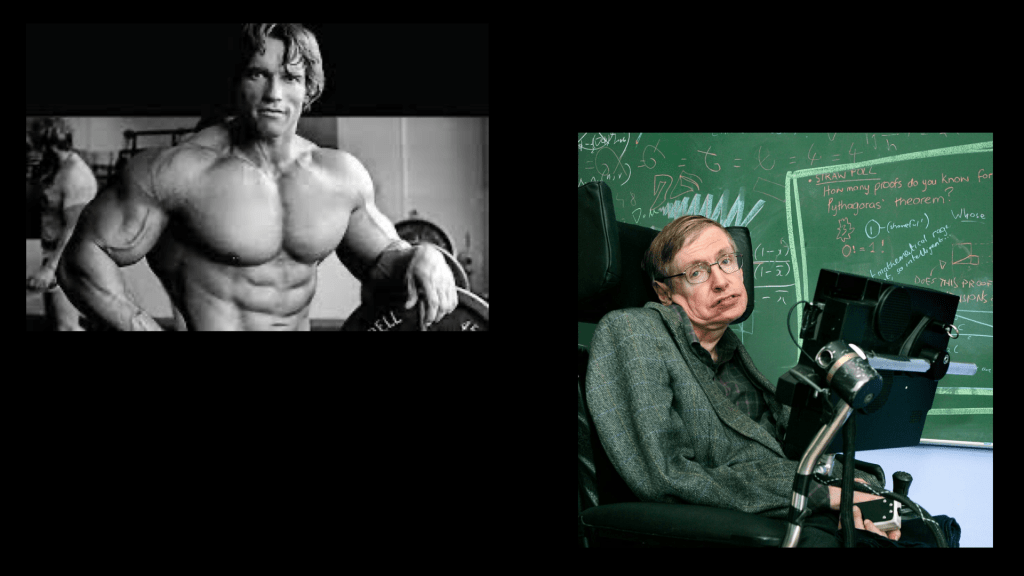
This is true whether I live in the body of Arnold Schwarzenegger or Stephen Hawking,
Serena Williams or Joni Eareckson Toda.
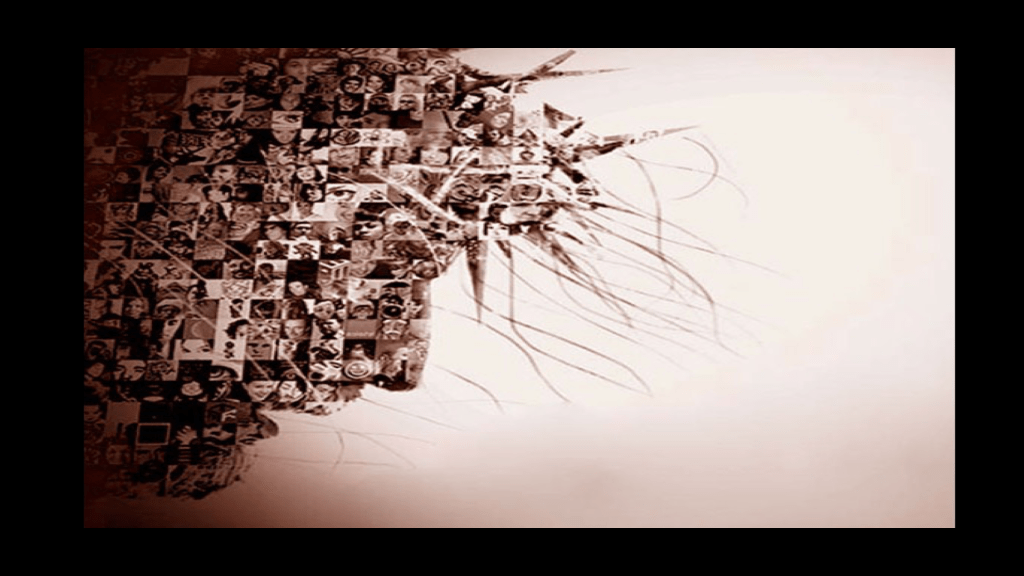
Considering this common reality of the “body” we all share, I find it particularly interesting that God likens each local church, and even the universal church, to a “body.”
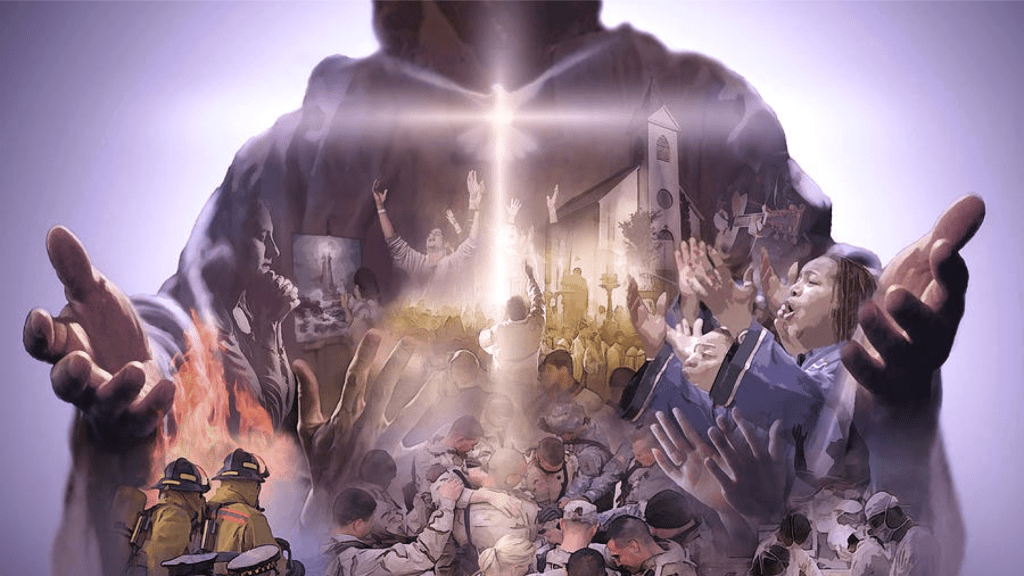
And through this metaphor suggests that “[t]here is no getting outside of the [B]ody we indwell” because we as a people are the “Body of Christ.” Said differently, we are the visible manifestation of God on earth for each other and for the world. How we treat each other in the world reflects how God treats each of us and the world.
You might say, “Oh, but I have been wounded and often feel disconnected from the [B]ody.” Yes, I understand. Quite a few of us feel this. But as with our physical bodies, so is it that “[t]here is no [B]ody-free (“excarnate”) experience of ourselves, … others, and the world around us.” This Body of Christ is who we are in the world, and why we may want to think seriously about our emBodied theology.
In a letter to the Romans, the Apostle Paul writes from Corinth in A.D. 56/57 to house churches scattered throughout the city of Rome.
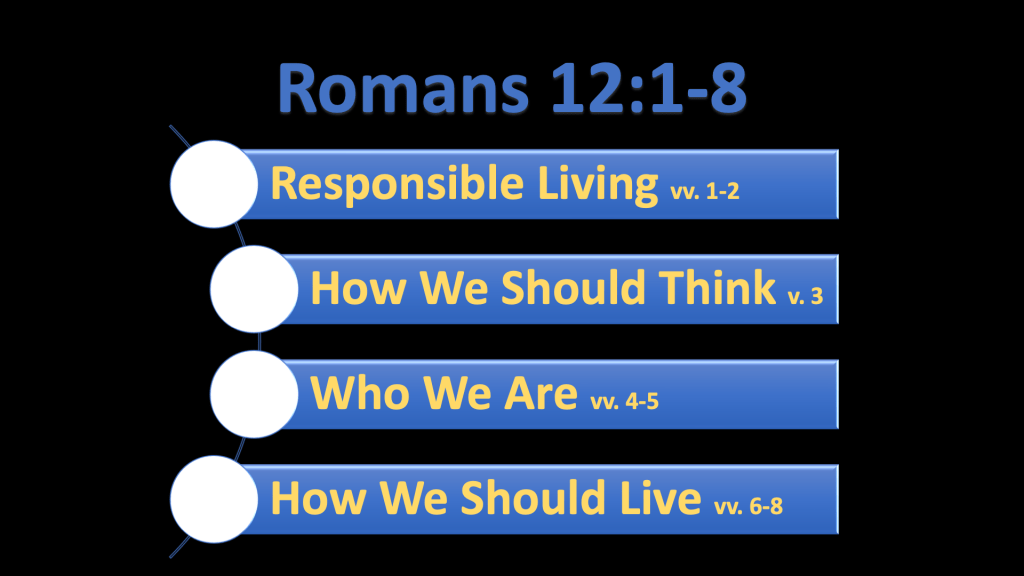
These are local churches that Paul did not plant and had not visited. But in his discussion of emBodied theology, he understands that he is describing something that is true in every church—local and universal—everywhere, for all time, until Christ returns. He unfolds his emBodied theology in Romans 12:1-8 by giving:
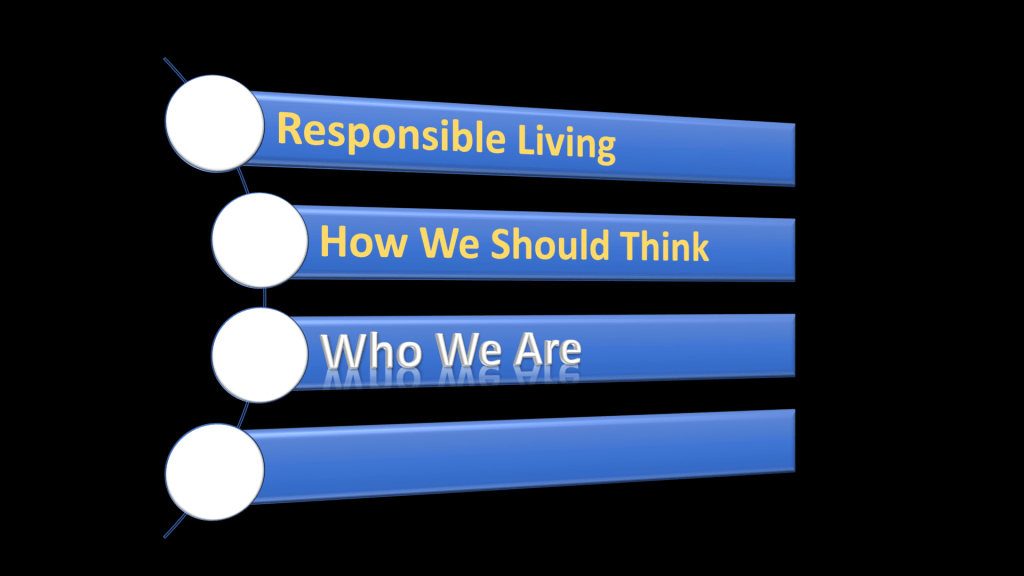
The Basis for Responsible Living (Rom. 12:1-2)
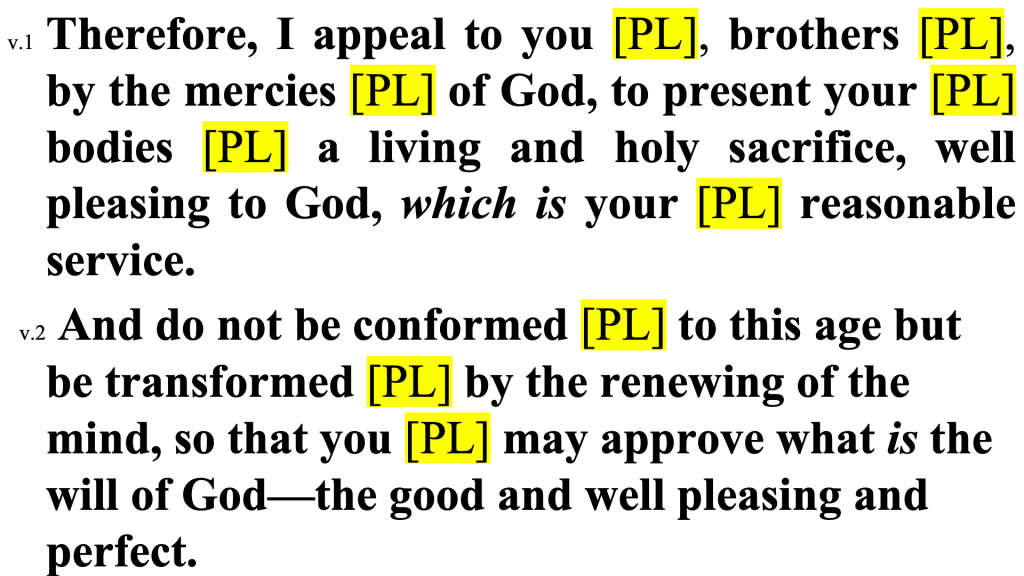
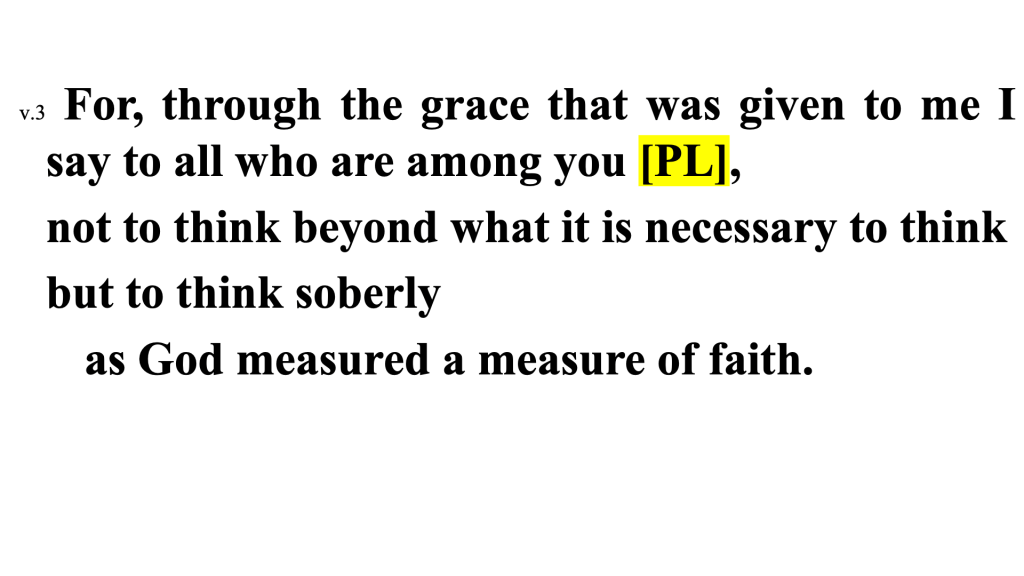
One interesting thing about this transitional statement is that it is not written to individuals but to the congregation—the Body. This isn’t immediately evident in an English translation, but if I put in brackets the abbreviation for Plural [Pl] by all the words that are plural, it immediately stands out:
Clearly, this is an exhortation to the community—to all of us as a group—and not just to the individual (as we may tend to read it). Speaking to the community, Paul urges them to present their bodies (plural) as a living and holy sacrifice—not our minds, not our spirits, but our bodies as a living sacrifice. What does that mean? He also says that we are to be separated from sin, or holy. Why say that? How is the community not living sacrificially and sinning?
We could imagine what is going on, but I think the book of Romans gives us some insight. There seems to be a division in the community. (We know how this happens.)
In Rome, the division appears to be ethnic. This church was in the western capital of the Roman Empire that itself was hostile toward the Jews. Emperor Claudius issued an edict around a.d. 49 expelling the Jews from Rome. The edict was repealed by the time Paul wrote this letter, but its effect may have continued. You can see the tension between the ethnic non-Jewish and ethnic Jewish members. The church may have been founded by Jewish believers, but now the non-Jewish members were dominating the Jewish members. This theme shows up numerous times in the book. In chapter 11, Paul reminds his non-Jewish members that they share in the promises made to Israel. They were grafted into the tree of promise, and if they become unbelieving, they can be removed. Then in chapters 14–15, there is a discussion about how the “strong” non-Jewish believers, who do not see themselves as subject to the traditions of Judaism, should limit themselves for the sake of the “weaker” Jewish believers who feel bound by conscience to follow the traditions that distinguished them from the world for centuries. As a body, they are being critical of one another, destroying one another; and they are doing it by how they treat each other in the community.
We can do the same thing. Communities become hostile, warring, and ravaged over:
race,
personalities,
styles of worship,
politics,
social issues, or
expectations of the manifestation of the Spirit.
It is in this conflicted context that Paul says that we are to bodily offer ourselves as a people who sacrificially live for each other, separating ourselves from our sinful disputes. And this way of living is the reasonable way for us to serve God and will please Him!
How are we to do this? Paul first says that it is by the renewing of our way of thinking—our [PL] mind. It may be a surprise to some of us, but how we think is not intrinsically accurate just because we are thinking it. For instance, for centuries, people thought the earth was flat,
and the sun rotated the earth.
It’s still in our language when we talk about the beauty of a sunrise or sunset. It’s phenomenological language, but it’s not technically accurate. It just doesn’t seem right to turn to someone and say, “What a beautiful rotation of the earth on its axis.” But this language came from a wrong way of thinking. The same thing can be true in our thoughts about ourselves and each other.
These ways of thinking are especially hard to break free of by ourselves because we cannot stand outside of the influence of our own thoughts. For instance, who am I; where do I find my identity? Am I valuable because of:
my race,
my gender,
my beauty,
my age,
my intelligence,
my education,
my profession,
my religion, or
because bright and beautiful people like me?
Said differently, am I valuable because I’m not like you?
All these ways of thinking are typical of our times and localities—
In Ireland and Scotland, hostility exists between Protestants and Catholics;
in Canada, hostility exists between those speaking English and those speaking French—at least, in Quebec;
in India the hostility exists between the brahmans and the untouchables;
in South Africa the hostility exists between the whites and the Africans;
in the United States the hostility exists between the whites and the blacks, the gays and the straight, the political right and the political left. And this hostility seeps into the church.
Therefore, Paul tells us not to be conformed to this world but to be transformed by the renewing of our mind! What does that look like? Paul shows us in verses 3-8.
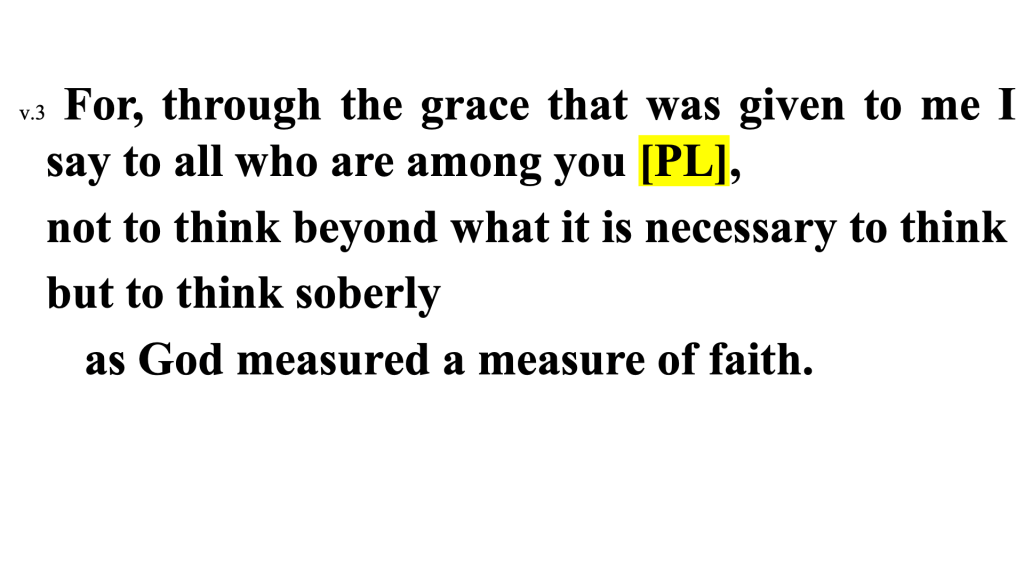
In verse 3, Paul discusses how we should think:
As an authoritative Apostle to the non-Jewish people (“through the grace that was given to me”) Paul directly identifies the conflict in the community: He repudiates those thinking too highly of themselves (super-mindedness, ὑπερφρονέω, hyperphroneō) and affirms those who are thinking correctly about themselves (sober-mindedness, σωφρονέω, sōphroneō). What brings about this ability not to think in excess of ourselves? The measure of faith God has given!
This “measure of faith” could be understood to be different for every Christian. However, that understanding seems to work against what Paul is addressing in the passage. If some people are given a greater measure of faith than other people, how will that help with the problem that some people have a higher view of themselves than they should? Wouldn’t that understanding support a super-minded attitude? “I’m right in this dispute because I have a greater measure of faith than you!”
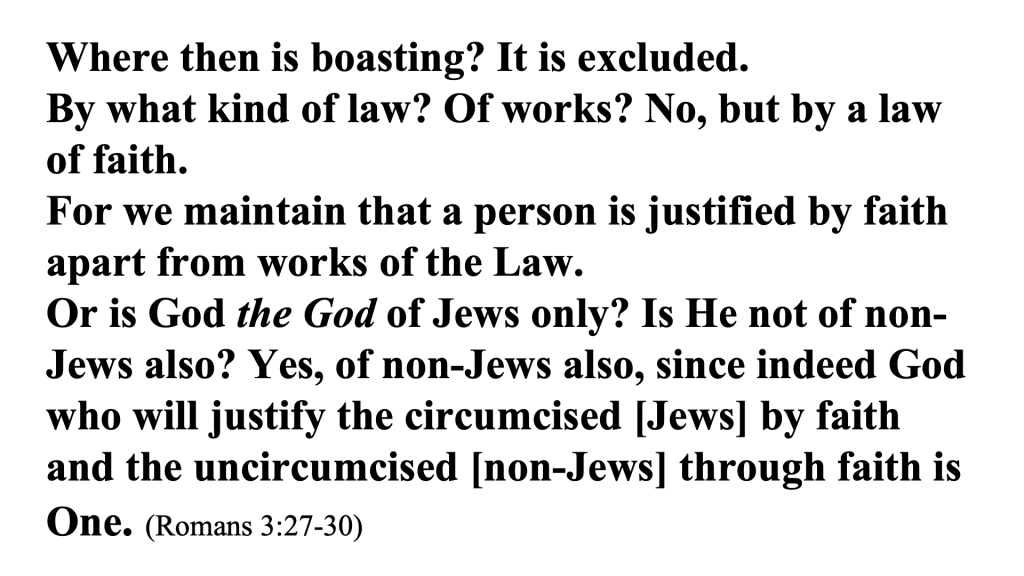
I think the logic of the passage supports a view that the “measure of faith” is the same for everyone—it is the faith that we all share in Jesus as Messiah. Paul says it this way in Romans 3:27-30:
We become sober in our thinking when we realize that we are all here because we have trusted in Jesus:
Jew/non-Jew;
Ph.D./no degree;
white/black;
beautiful/ugly;
bright/struggling;
strong/weak;
politically right/left;
male/female;
Protestant/Catholic.
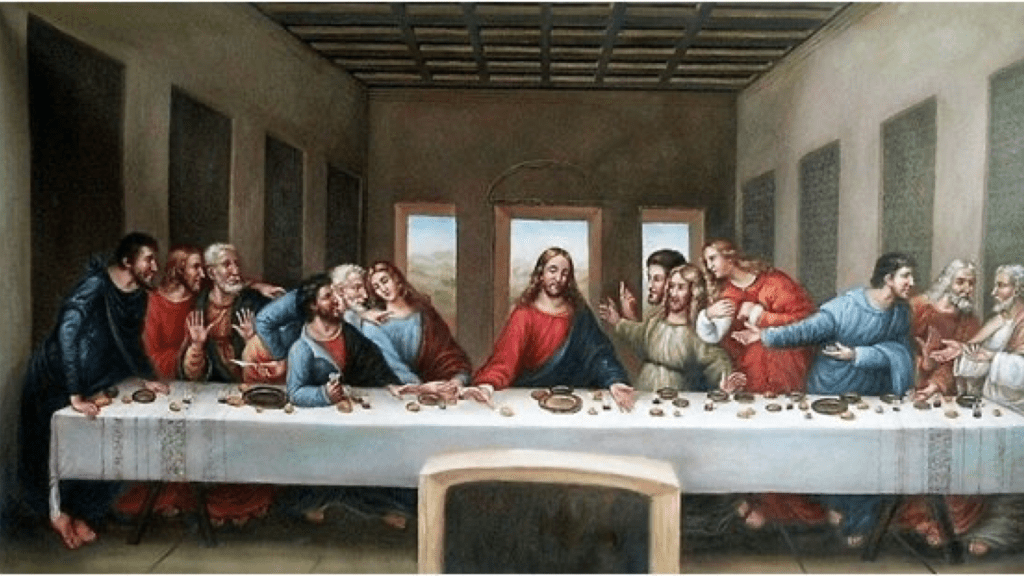
Jesus levels the field for all of us. We are all here because we believe He has paid for wrongs we cannot undo. When we come to the Lord’s table,
it is a graphic picture that all of us—each and every one of us—recognize our common need and dependence on Jesus. And that should lead to sober thinking about ourselves.
Paul now explains how this sober way of thinking shows itself in the Body of Christ:
Paul first talks about our human body, then he transports us into the Body of Christ.
First Paul talks about the cooperating nature of our human body.
When you’re seated at your computer, your mind is thinking about what to create, your eyes are looking at the screen or the keyboard, your back is holding your body erect, your feet are keeping your body in balance, and usually this all occurs simultaneously without any thought about the process—just the idea you are creating. That’s how the members of our bodies work together.
My brother, Walt Malick, lost his left leg in a motorcycle accident. He has a very expensive and sophisticated prosthesis. Every time I am running and have to move from a curb onto the road, I think about how my body adjusts without any hesitation—one foot compensates for the difference in height, and, other than a groan now and then, it’s seamless. My eyes see the different terrain, my entire body adjusts to the change, and I keep on running. However, Walt’s body doesn’t work that way. He has to consciously anticipate and adjust for every change in the terrain, or he will fall. Why? Because one of his members isn’t whole, and its replacement isn’t functioning as it should. Whether you’re typing, running, driving, reading, sleeping—your body is where you reside, and your various members navigate your life in this canyon of time.
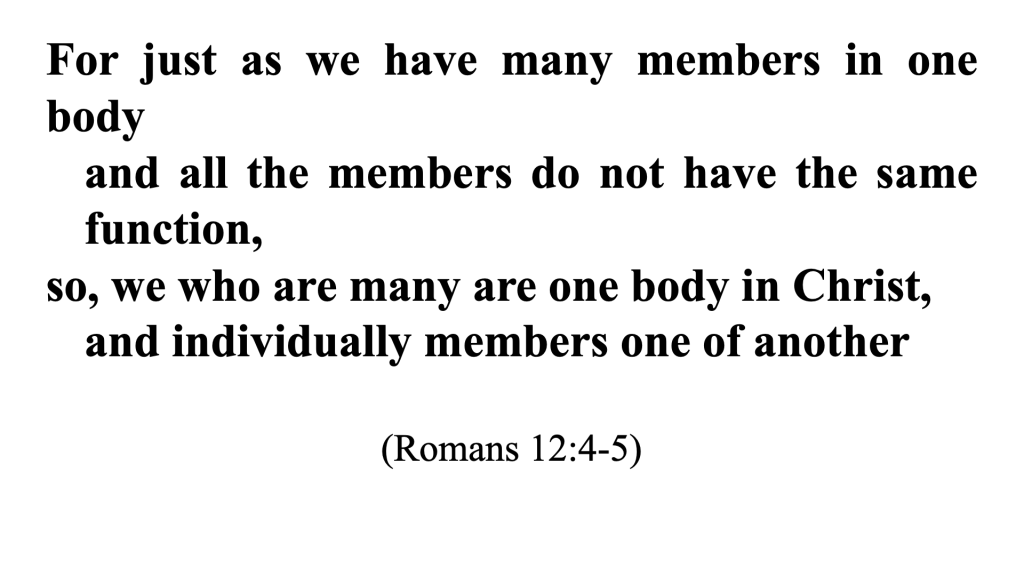
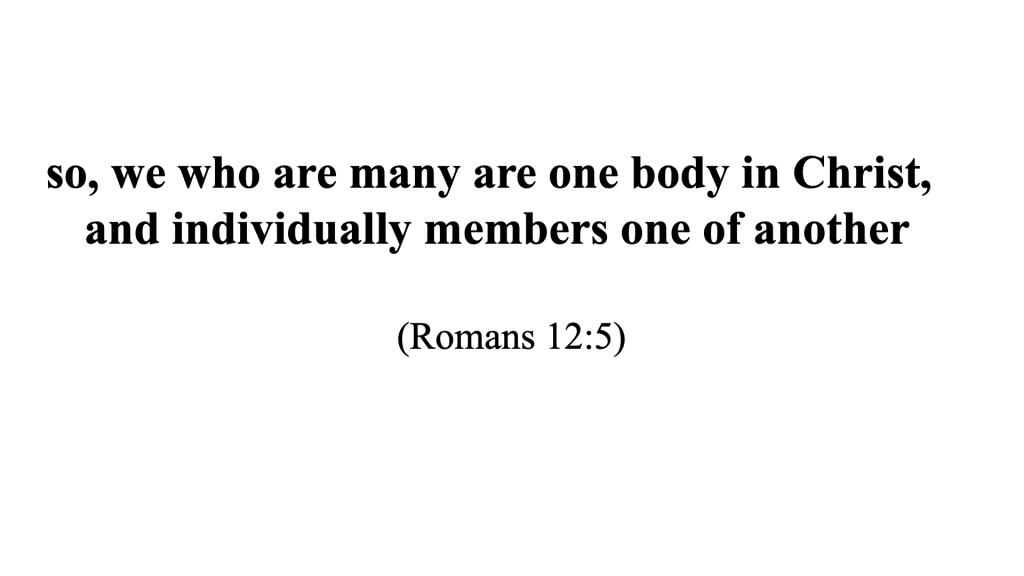
In verse 5, Paul now takes our embodied experience and applies it to us a community in Christ:
Our lives are intwined and dependent on one another. Together, we are functioning as the visible representation of Christ on earth! Just as we experience and express our individual lives through our physical bodies, so is it that Christ experiences and expresses His life through His metaphorical Body—us! There is no getting outside the Body He indwells—us!
Do I want to experience God’s forgiveness? I find it in what you do with me when I fail. Do I want to experience a relationship with God? I find it in my relationship with you. Do I want to know more about God? I find it in what you share with me. Do I want to see God’s leadership in my life? I find it in the leadership you offer me. Do I want to understand that God is merciful to me? I find it in your expressions of mercy to me. At least that is how Paul explains it in verses 6-8.
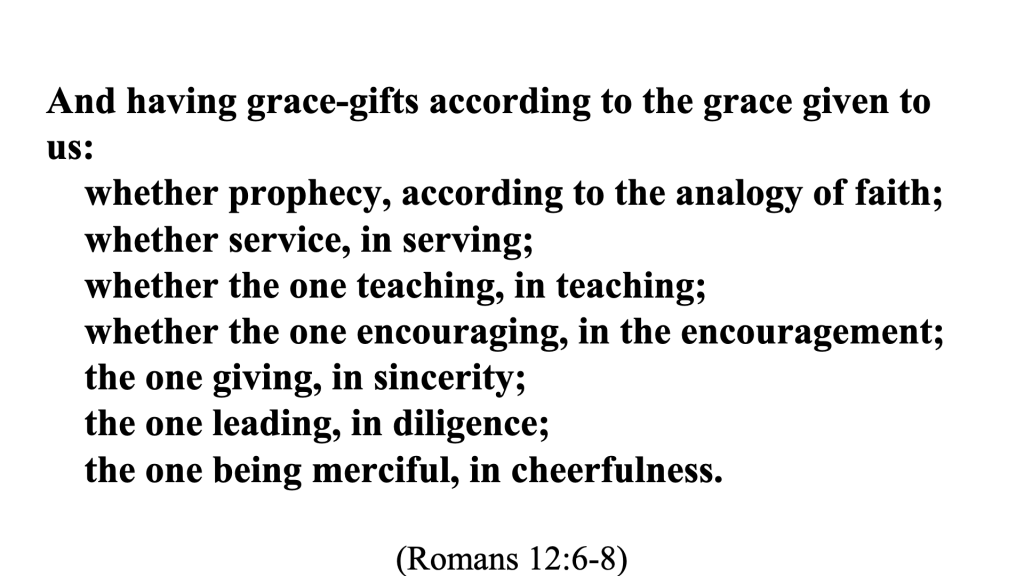
In this list of seven grace-gifts, Paul is careful to not describe offices or positions like apostles and pastors, or even persons, like prophets, teachers, or leaders. I think this could be due to how prominent people are acting out in the Roman church. Instead, he focuses on what the gift is, or does, and how the gift is expressed so that everyone in the church can see themselves in the outworking of God’s grace.
“Prophecy” involves the revelation and interpretation of divine secrets. It may involve foretelling, but it also includes forth-telling for guidance, exhortation, or remonstration. Because of the human element in prophecy—a person’s individualism and subjectivism—prophecy is often tested for accuracy. Here, the standard is “according to the analogy of faith.” The word “analogy” has a mathematical background indicating the right ratio or proportion of one thing to another. Here the analogy is a comparison of the prophecy with the measuring rod of the faith. Pastor Bart often says we are a people of the Spirit and the Word. So, when one is given the gift of revelation and interpretation of divine secrets, that prophecy must be tested by the standard of faith found in the Scriptures! As Paul says in 1 Cor. 14:29, “Let two or three prophets speak, and let the others pass judgment.” Likewise in 1 Thess. 5:20-21 “Do not despise prophetic utterances. But examine everything.”
The word for “service” was often used for household service—waiting on tables or serving meals. Some people do not find this kind of work a burden. They love the necessary work of daily life, and Paul says they should get on and serve.
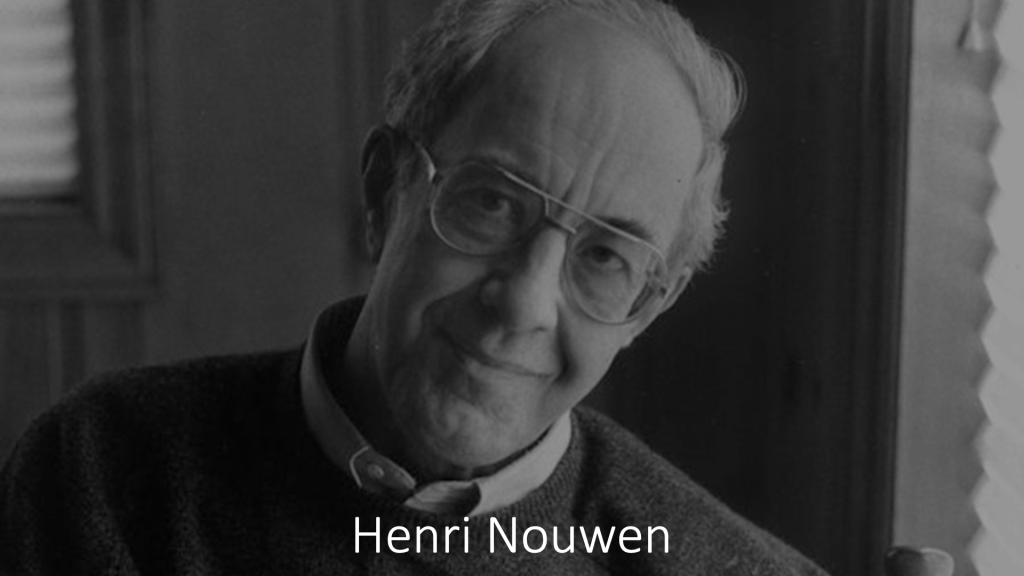
This kind of work often does more than meet the most basic of needs—it speaks to the rest of us in the Body. Henri Nouwen was a Roman Catholic Priest who taught at Harvard and Yale.
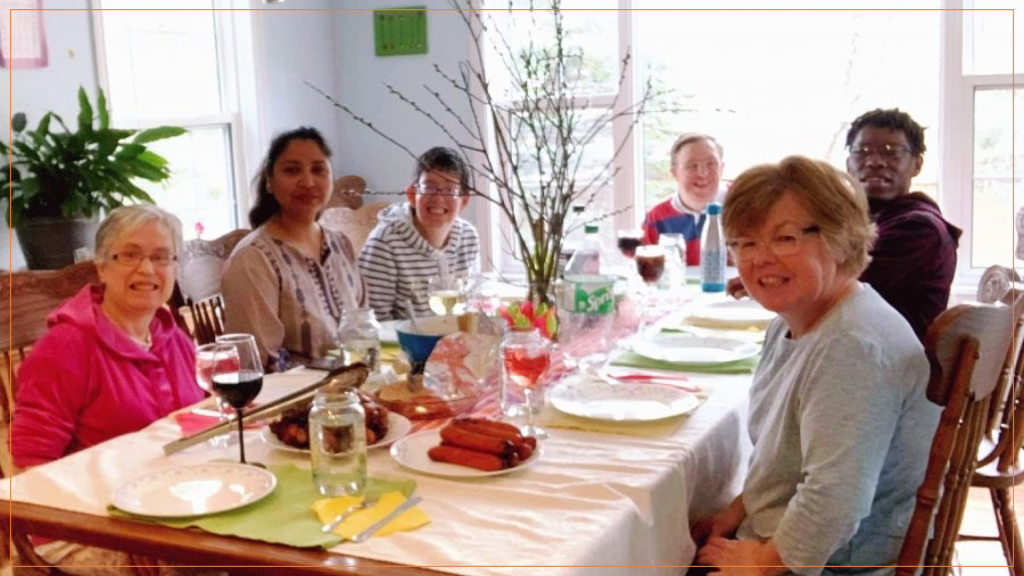
He went to France for a year to train for a ministry among the disabled at an organization called L’Arche. In his diary, he talks about one of his days of service which he titles: “L’Arche Built upon the Body.” You might also think of parents with small children as I read:
One of the most important things that [the leader] . . . is saying to me during this retreat is that L’Arch is built upon the body and not upon the word. This helps to explain my struggle in coming to L’Arche. Until now my whole life has been centered around the word: learning, teaching, reading, writing, speaking. Without the word, my life is unthinkable. A good day is a day with a good conversation, a good lecture given or heard, a good book read, or a good article written. Most of my joys and pains are connected with words.
L’Arche, however, is built not on words, but on the body. The community of L’Arche is a community formed around the wounded bodies of handicapped people. Feeding, cleaning, touching, holding—this is what builds the community. Words are secondary. Most handicapped people have few words to speak, and many do not speak at all. It is the language of the body that counts most.
* * *
I feel a deep resistance against this way. Somehow, I have come to think about eating, drinking, washing, and dressing as so many necessary preconditions for reading, speaking, teaching, or writing. Somehow the pure word was the real thing for me. Time spent with “material” things was necessary but needed to be kept to a minimum. But at L’Arch, that is where all the attention goes. At L’Arch the body is the place where the word is met. It is in relationship to the wounded body of the handicapped person that I must learn to discover God.
This is very hard for me. I still find a long meal in the middle of the day a waste of time. I still think that I have more important things to do than to set the table, eat slowly, wash the dishes, and set the table again. I think, “Surely we must eat, but the work which comes after is what counts.” But L’Arche cannot be endured with this mind set.
I wonder when and how I will learn to fully live the Incarnation. I suppose that only the handicapped people themselves will be able to show me the way. I must trust that God will send me the teachers I need.[3]
Those with the gift of service should serve—for all our benefit!
The next gift is described as the one who teaches. We’ve all had experiences with teachers who stirred our souls. I often think of the two on the road to Emmaus who commented after Jesus had explained to them all the things concerning Himself in all the Scriptures:
This is the effect on the Body that someone has with the gift of teaching. I can still remember my experiences under Pastor David Burnham at the Chapel while I was in college.
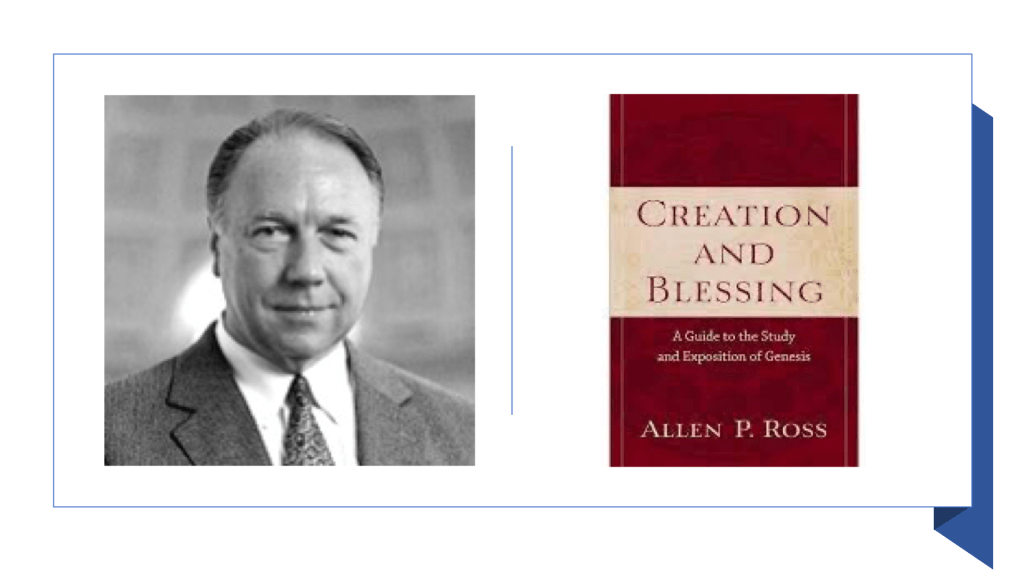
After the Sunday-evening service, I would come home, pull my garbage can to the curb under the cold winter stars and say to myself: “This was the best day of the whole week! I can’t believe I have to wait another week for Sunday to come.” When I would leave Dr. Allen Ross’s classes on Genesis in my fourth year of seminary (when many of us felt like we’d heard it all),
I would say to myself: “I had no idea this was in the Scriptures.” And you know, these gifts are not gender specific! The gift of teaching is given to women as well as men. We’ve seen it when we’ve heard Kathy Brookins teach, or Cheryl Ross, or Cindy James. One of the most gifted teachers I’ve ever heard is my wife, Lynn. So, the one with the gift of teaching should get on and teach! You might say, “How do I know if I have this gift, or any of the other gifts?” I would say, “Do you have a desire? Try it out.” Throughout seminary I taught children at church. People in the Body will let you know when they see your gifts.
The next gift is the gift of exhortation. This word is παρακαλέω and it’s the same word used in 12:1 when Paul began his exhortation in this passage. It is often used to describe the person of the Spirit (παράκλητος, paraklētos), and it can mean to comfort or to encourage by exhortation. Literally, it is someone who is “called beside” someone else.
In George MacDonald’s book, The Curate’s Awakening, he describes a conversation between a member in a congregation, Mr. Polwarth, and a curate (or pastor), named Mr. Wingfold. Polwarth is discussing his observation that Wingfold has been preaching someone else’s sermons as his own. In the conversation, Polwarth encourages Wingfold by exhortation:
[Polwarth] “Have you never preached a sermon of your own thinking? I don’t mean of your own making—one that came out of the commentaries. I am told that commentaries are the mines where some of our most noted preachers go to dig for their first inspirations. But have you never offered one that came out of your own heart, from your delight in something you had discovered, or from something about which you felt very strongly?”
“No.” answered Wingfold. “I have nothing. I never have had anything worth giving to another.”
* * *
[Polwarth:] “I will come to the point practically: a man who does not feel that he has something in his own soul to tell his people should turn his energy to the providing of such food for them as he finds feeds himself. In other words, if he has nothing new in his own treasure, let him bring something old out of another man’s.”
“Then you do think a man should make up his sermons from the books he reads?”
“Yes, if he can do no better. But then I would have him read much—not with his sermon in his thoughts, but with his people in his heart. Most people have so little time for reading or thinking. The office of preaching is meant first of all to wake them up, next to make them hungry, and finally to give them food for that hunger. And the pastor has to take thought for all these things. For if he doesn’t feed God’s flock, then he is no shepherd.”[4]
You might say, “That takes real courage to speak like that to your pastor!” It does, and perhaps that is why the Body needs someone with the gift of exhortation. You might also say, “Well, that’s just fiction. No one would really do that.” But “Fiction is the great lie that tells the truth about how the world lives.”[5] No one person can have all experiences, and narratives show us what we might otherwise not know from our own experiences. For instance, you know Leo Tolstoy is on to something when he begins Anna Karenina with the statement:
“Happy families are all alike; every unhappy family is unhappy in its own way.”
In a culture where we hardly speak to one another anymore, we should allow fiction to tell us things that previously our parents or grandparents might have told us. One of those is how one might provide an encouraging exhortation through the gift of the Spirit.
The next gift describes someone who gives (μεταδίδωμι, metadidōmi) and says that this is to be done in simplicity or sincerity (ἐν ἁπλότητι, en haplotēti). It is sobering to be on the receiving side of this gift.
When I was in seminary, we had post office boxes where we received all our mail—including returned papers from classes. On a couple of occasions, I remember receiving an envelope with only my box number on it, and inside would be cash! The wonderful thing was that I never knew who provided it. I’m sure it was someone I knew, but “Who?” In the end it made me see it as coming from God, and I would thank Him. I’ve been told that once or twice a year, this very same kind of thing happens here at Fullness. Someone sends a significant, anonymous gift to the church through a foundation that cannot be traced to the giver. There is something so simple and sincere about this kind of gift and it causes the one receiving the gift to look to God as the ultimate source. Do you see how this kind of gift has an effect on the Body?
The next gift describes the one who leads. It’s a generic term describing one who stands before others (προΐστημι, proistēmi). This kind of leadership is to be done in diligence. The word could be translated in “swiftness” or “speed” (σπουδή, spoudē). But it is used again in Romans 12:11 where they are told to “be devoted to one another in brotherly love . . . not lagging behind in ‘diligence.’” We know the diligence with which some lead in this congregation, whether its Larry behind the scenes, our elders and trustees, the pastoral staff. It may be the ability to help others who are about to face catastrophic illness to think in advance about the need to draft a power of attorney, or plan for future placement, the ability to lead others through the valley of deep darkness, the ability to plan the Body’s finances, the ability to form leadership for the future. This should not be taken on any less diligently than we take on projects in our work.
Finally, Paul lists the gift of mercy (ἐλεάω, eleaō). This word is from the same word group as the word used in 12:1 where Paul encouraged us by the “mercies of God” (διὰ τῶν οἰκτιρμῶν τοῦ θεοῦ, dia tōn oiktirmōn tou theou). God felt compassion and concern over our brokenness and provided for us. Now Paul tells us that God has given this gift of mercy to the Body. Paul also says that mercy should be exercised with cheerfulness. The word for cheerfulness is the word from which we get our English term, “hilarity” (ἱλαρότης, hilarotēs) When you need someone to be merciful to you, you will be very aware of the tone in which they offer mercy. What do we do when we see someone in deep trouble?
In another one of these fiction novels I’ve been reading, titled The Covenant of Water, which takes place in the country of India, (another “great lie that tells the truth,”) a main character, called Big Ammachi (having the sense of great mother), takes her young daughter, called Baby Mol (which means “Baby Girl”), to be seen by a doctor, Dr. Rhune, to figure out if something is wrong with her developmentally. I was so moved by Dr. Rhune’s merciful care as he gives his difficult diagnosis:
“I do know what is going on with Baby Mol.” “You do?” Big Ammachi says, thrilled. “Yes. You see, I recognized her at once.” “What do you mean? You’ve seen her before?” “You could say that.” He examines Baby Mol’s hands. “I expect she has a swelling, a hernia by her belly button, am I right?” He lifts Baby Mol’s shirt, and it’s as he says, a bulge that Big Ammachi thought nothing of, since it never troubled her little girl. Baby Mol giggles. The doctor has her walk for him, put out her tongue. He rests his huge forearms on the desk and leans forward. “What Baby Mol has is a well-known affliction. It’s called ‘cretinism’—but the name is not important.” It means nothing to Big Ammachi in any case. “There’s a gland here in the neck. The thyroid. You’ve seen it swell into a goiter in some people?” She has. “That gland produces a vital substance for the body to grow and the brain to develop. Sometimes at birth the gland doesn’t work. Then children develop like Baby Mol. The tongue. The broad face. The hoarse voice. The thickened skin. She’s a smart child, but she’s slow to learn what others her age know.” He’s listed all the things about her daughter that she resisted seeing. “You can tell all this by looking at her?” Big Ammachi asks, still doubtful. He steps to his bookshelf and without hesitation picks out a volume. He rifles through pages just as her father could with his Bible, familiar with chapter and verse. He turns the big book around to display a photograph. It’s true: Baby Mol resembles this child more than she resembles her blood relatives. Baby Mol puts her broad finger on the page and giggles in recognition. “Is there medicine to cure this?” He sighs and shakes his large head. “Yes and no. There’s an extract of the thyroid, but it isn’t available in India. Even if it were, it would have to be administered from birth. At this point, no amount of that extract will reverse what you see.” Big Ammachi looks at this man whose hair and beard are like spun gold, and whose eyes are the color of the ocean. . . . More than the color, it’s the kindness in them that is so striking; it only makes his words more painful for her to hear. The door into her daughter’s future has been pushed open. The view is crushing. She wants to argue. He reads her mind. “She’ll always be a child. That’s what I have to tell you. She’ll never grow up, I’m sorry to say.” He smiles at Baby Mol. “But what a happy child! A child of God. A blessed child. I wish I had some other news for you. I wish I did,” he says, his face grave, those kind eyes now full of sorrow. Her mother looks on, her eyes wet, a hand on her daughter’s shoulder. Baby Mol is her happy self, too absorbed with the doctor and his beard and the instruments on the table to be affected by the discussion. “Bless you,” Big Ammachi says, her voice choking. She has just thanked this man who gave her this terrible news, habit being so strong. “Please understand. This happened before her birth. She was born this way. Nothing you or anyone else did caused it. Understand? This isn’t your fault. In Jeremiah, doesn’t God say, ‘Before I formed thee in the belly I knew thee; and before thou camest forth out of the womb I sanctified thee’?”[6]
Dr. Rhune is merciful, in a cheerful way, and he helps others—the Body.
Some of us may be thinking this morning: “Well, okay, but my body is broken, or I am broken in this body, so how am I supposed to function in the Body of Christ?” (Pause) I understand some of this reality, and it’s hard.
I failed first grade because I couldn’t read. I mean I could read just fine, but then I was sexually abused as a little boy, and suddenly I couldn’t read at all. Failing first grade set me up for a lifetime of feeling intellectually inadequate. And I embarked on an unknown, but empty quest to validate myself through other people who I thought were more intelligent than me. It was a long search that left many tears in its wake. So, I understand some of what it means to be broken in this body. How do you contribute to the Body of Christ when you’re messed up?
I mentioned my brother, Walt, earlier. He was operating a motorcycle going up one side of a hill, when he met an automobile going up the other side of the hill—left of center—at the top of the hill. He lost his left leg and permanently damaged his left arm. Another motorist stopped to help, and the Eagle Scout in him had enough presence of mind to tell the person to take off his belt and tighten it around his leg so he wouldn’t bleed to death. He was airlifted to a hospital in Columbus, Ohio where he remained on life support for a long time. When we went up to Ohio, I was prepared for his funeral. But Walt was a fighter. While he was in intensive care, the driver came to visit. Walt had tubes down his throat, so he couldn’t talk or see anyone. But when he learned the driver was there, wanted to get a message to him. His wife, Polly, gave him a piece of paper to write on, but he couldn’t control his hand and kept writing one letter over another. Polly said, you write, and I’ll move the paper. He wrote down on a piece of paper that the elders of his church should tell the driver that he forgave him, and share Christ’s forgiveness with him. As a result, the driver trusted in Christ.
There my brother was—a man with a broken body—but he used that brokenness to be a visible manifestation of God on earth by forgiving another just as he had been forgiven.
Will we? . . . Will we?
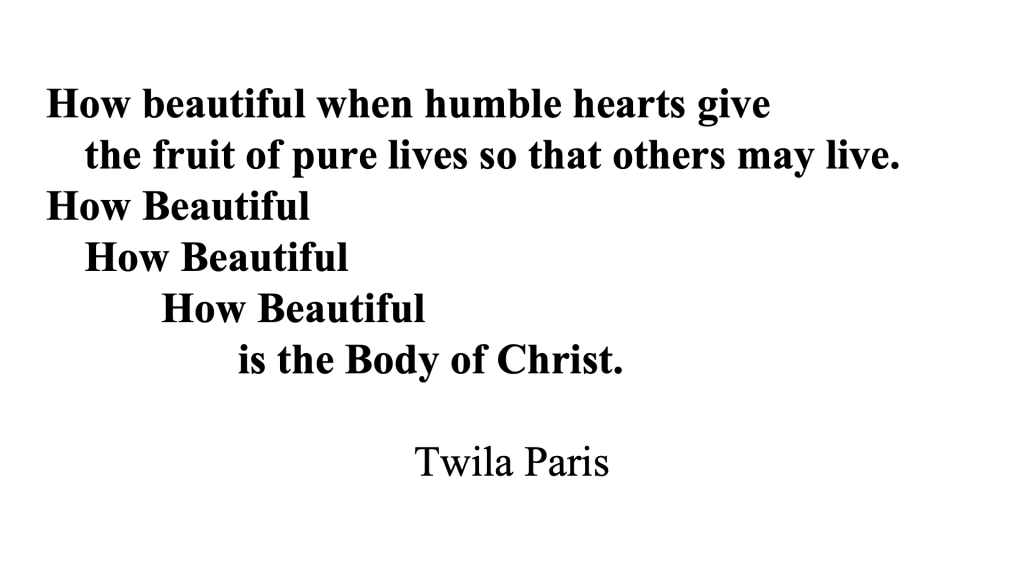
Twila Paris said it this way:
[1] Samantha G. Smith, “Assaulted Body, Assaulted Faith: The lived experience of sexual assault/violence in Christian women,” p. 143.
[2] Katrin Bosse, “Being Some-Body in the Body of Christ: Dimensions of Embodiment in a Christian Perspective,” Scottish Episcopal Institute Journal 5.21, N. 3 (September 18, 2021): 160.
[3] Henri J.M. Nouwen, The Road to Daybreak: A Spiritual Journey (New York: Image Books, Doubleday, 1988), 150-51.
[4] George MacDonald, The Curate’s Awakening, (Minneapolis: Bethany House Publishers, 1876/1985), 46-47.
[5] Abraham Verghese, The Covenant of Water (New York: Grove Press, 2023), 256.
[6] Abraham Verghese, The Covenant of Water (New York: Grove Press, 2023), 206-207.

















 All Things Biblical
Leave a comment